 Track an order
 Buy It Again
 Favourites
 Manage account
 Rewards
 Subscriptions
 Find a store
 Help centre
What are UPFs and are they bad for you?

Written byH&B editorial team

Reviewed byDan Clarke, Registered Nutritionist (RNutr)
Summary
1What are UPFs?
UPFs are typically mass-produced foods that undergo extensive processing and often contain additives.
2What are the potential dangers of UPFs?
Research suggests that eating more UPFs may be linked to an increased risk of certain health conditions.
3So, should I cut out UPFs?
Not necessarily. Some UPFs provide important nutrients, so it's about making balanced choices rather than cutting them out completely.
Think you’re a healthy eater? The news at the moment might tell you otherwise. Not to worry, we’re here to set the record straight...
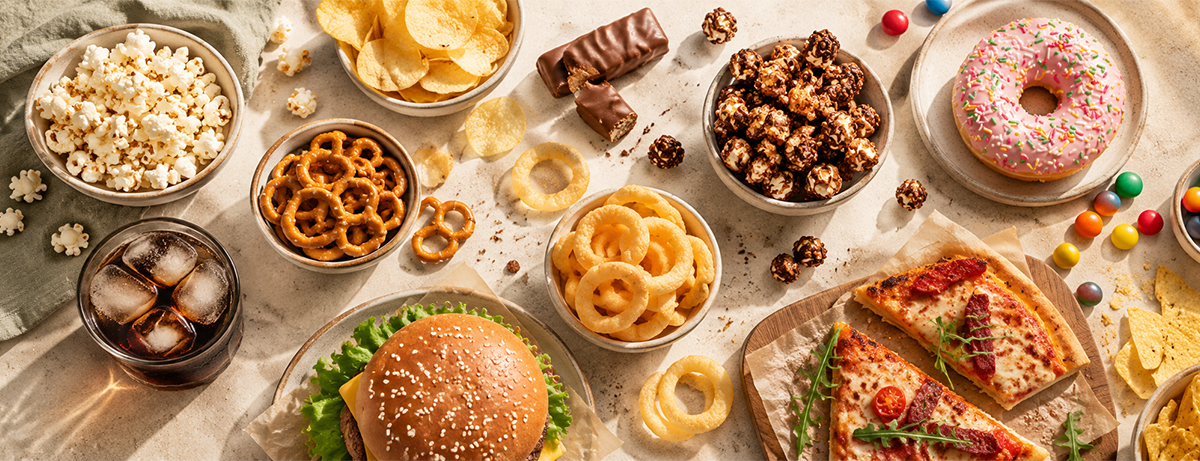
Ultra-processed food (commonly known as UPF) is having its time in the spotlight, with its health concerns the focus. Naturally, the finger’s pointed at fast foods like burgers and chicken nuggets, but the category can also include ready-made sandwiches, sauces and (gulp) even protein bars. The problem – as some see it – is the level of processing a food goes through. But before you raid your cupboards and start scrutinising labels, let’s take a beat and find out if it’s really as simple as ‘good’ and ‘bad’ foods (spoiler: it never is).
To help us sort the fact from the fad, we asked nutritionist Dan Clarke and Senior Scientist Shaun Ward for their expert takes on identifying UPFs, simple swaps and whether or not they really matter. Prepare to be informed...
What are UPFs?
There's still a lot of confusion on what the definition of ultra-processed food (UPF) is, however, generally most people class it as a food that has been processed in an extreme way – typically mass-produced, “formulated mostly or entirely from substances extracted from foods or derived from food constituents” and “made possible by use of many types of additives”.1 However, many foods undergo some kind of processing – flour is milled and coffee is turned into granules. But that doesn’t make them ‘bad’ for you. In fact, processing can also be used to make foods safe such as removing harmful bacteria from milk or fortifying products with added vitamins and minerals.
According to nutrition professor Carlos Monteiro, UPF refers to food made to be “highly profitable”, “convenient” and “hyperpalatable”.2 It’s not just the processing, but also its extent and purpose. In his opinion, UPF contains “industrial” substances you wouldn’t find in your kitchen.² But this is where it gets tricky. “Fortified ingredients (for example, added vitamins and minerals) can be classed as ultra-processed foods, but you've made them healthier,” Dan says.
H&B Senior Scientist Shaun Ward agrees that the distinction matters. “Unfortunately, ‘ultra-processed’ is increasingly becoming synonymous with ‘unhealthy’, but scientifically those two things aren’t interchangeable.” He explains that UPF classification focuses on how food is made and what goes into it, rather than its nutritional quality. So, everything from sugary drinks to wholegrain bread, high-fibre cereals and baked beans can fall into the same category.
Processing can be used to:3
make foods safe, for example milk is pasteurised to remove harmful bacteria
make foods suitable for use, such as pressing seeds to make oil
preserve foods or help them last longer, such as tinned or frozen foods
How can you tell if a food is a UPF?
You might have heard that the best way is to check the label for ingredients that sound like they’re from a lab rather than your kitchen. But just because you don’t recognise an ingredient, it doesn’t mean it’s a red flag. Vitamins and minerals can often be given their Latin names or expressed as chemicals. “Even oxygen is used for packaging as an E number, and people say to avoid E numbers (E 948)”, says Dan.
If that's not a good rule of thumb, then what is? Well, one way of determining a UPF is the NOVA food classification system, based on four categories of processing:4
| NOVA Category | Food classification | Examples |
|---|---|---|
| Group 1 | Unprocessed or very minimally processed 4 | Fruit and veg, meat and fish |
| Group 2 | Salt, sugar, fat and oils extracted from natural foods 4 | You might use these when cooking at home – for example butter or corn starch |
| Group 3 | Processed foods - produced in a factory with added extras like preservatives or flavourings. But they still only contain a few ingredients, all from groups 1 and/or 2 4 | Tinned fish or veg, fresh bread and freshly made cheese |
| Group 4 | Ultra-processed foods 4 | These contain no or very few group 1 ingredients. They could be sweetened, enhanced, preserved, shaped, flavoured or coloured...4 |
It's important to note that not all scientists currently agree on what exactly constitutes a UPF. While some people follow the NOVA classification system, others may have different definitions. One thing that most experts agree on, though, is that foods high in fat, salt or sugar (HFSS) should be eaten in moderation and ideally reduced.
What are the potential dangers of UPF?
The understanding around UPFs is still an evolving and emerging area. One study discovered that there was an association with the amount of UPFs women ate and their risks of high blood pressure.5 Fears around it certainly seem to be growing, as last year over 30% of us cut our UPF intake.6 And that’s just our physical health. According to GOV.UK, “the sheer availability of UPFs compared to non-UPFs... will impact health beyond purely biological terms.”7
Should I cut out UPF completely?
In short, no – and cutting them out completely isn't necessarily the answer. Ultra-processed foods (UPFs) make up nearly 60% of the UK diet, rising to as much as 80% among younger people and those on lower incomes.8-11 Some UPFs can also provide important nutrients and offer convenient, affordable options. As the British Nutrition Foundation points out, “blanket advice to avoid UPF may have unintended consequences that have not been fully investigated for different groups within the population.”¹² Shaun agrees: “Blanket advice to avoid all ultra-processed foods could have unintended consequences.”
For many people, affordable, convenient options make healthy eating more achievable. And cutting out UPFs entirely could mean missing out on nutritious everyday foods. For example, baby formula and fortified foods are UPF. Bread – UPF if not freshly baked – contributes to over 20% of older adults’ fibre intake.¹² And adequate fibre (which most of us don’t get enough of) could increase their chances of living a healthier life by up to 80%.13,14
“Often the choice is taken away from people,” says Dan. He explains that UPF is generally cheaper, so “if you're on a limited budget, the first thing you do if you’ve got hungry kids is to give them the calories because they need that for attention at school.”15 As with any food, it’s a battle of pros and cons. There are several reasons you’d choose a protein bar over chocolate for your workout, even though both can be considered UPF. It’s certainly a good idea to limit your intake of HFSS foods if you want to decrease your overall health risks. But, for many people, it’s not totally avoidable.
Is it really processing that’s the problem with UPFs?
We already know that ‘junk food’ isn’t good for us in large amounts. It's high in saturated fat, salt and sugar.16 So what makes UPF any different? Well, the evidence is mixed. One study gave two groups of people a diet made up of meals equal in fat, sugar and salt – but one diet plan was made of mostly UPF and the other was UPF-free (as per NOVA classifications). Each participant could eat as much of their meals as they wanted. After two weeks trying each diet, both groups gained weight on the UPF plan.17 But that could be because they ate an average of 500 calories more per day.17 So, maybe UPF isn’t inherently unhealthier than HFSS, but it makes us want to eat more. We’ll delve into that later...
Separating the effects of processing from a food's nutritional content also isn't straightforward. “One of the challenges in interpreting the research is that there is substantial overlap between ultra-processed foods and foods we already know we should limit,” explains Shaun. UK data show that more than half of foods classified as UPF are also high in fat, salt or sugar. So, when research links UPFs to poorer health, it's difficult to know how much is down to processing itself and how much is linked to other dietary factors.
“That doesn’t mean we should ignore the UPF evidence, but it does mean we need to be careful about what conclusions we draw from it.”
Is UPF addictive?
Some people believe that UPFs are addictive, possibly because they’re often low in the nutrients that keep us satisfied. It’s often soft and easy to eat, meaning it’s got mass appeal and can be devoured quickly (leaving you wanting more before fullness kicks in).
While this may be a legitimate criticism of certain industries and foods, there are also reasons why some functional foods – such as your protein bar – may be UPF. These are designed to provide nutrients you need in the moment, such as before or after that big workout.
So, what should we do about UPFs?
A 2024 report from the House of Lords Food, Diet and Obesity Committee advised the government to “act now” and “develop clear guidance for consumers and the food industry regarding UPFs in dietary recommendations”. They also highlighted that “the distinct impact of UPF-specific properties like hyperpalatability and additive content requires further investigation”.18
As with everything in life – and certainly in your diet – it’s about balance. Try to add nutrition to your diet rather than taking foods away: add plants, seeds, nuts, fruits and whole foods to your meals where you can.
Simple swaps for UPF: Dan’s top tips
Instead of relying on ready meals... batch cook: “Nothing wrong with microwaving leftovers. You can do it with most things, as long as you heat them up properly and they're frozen within a couple of hours.”
Instead of always reaching for crisps and fizzy drinks... prepare your portions: “Anything you automatically cook as one thing and divide up into portions – like tray bakes - is really easy.”
Instead of grabbing a quick fix... reheat leftovers: “If I know I'm going to freeze or batch cook something, I'll undercook it. If you already cooked it perfectly, it's then got to defrost and then cook again.” (Note that this doesn’t apply to meat).
FAQs about UPFs
Rather than cutting out all ultra-processed foods, focus on those we already know are best eaten less often. These include foods high in saturated fat, salt or free sugars, or low in fibre, such as sugary drinks, sweets, cakes, biscuits and processed meats.
Research increasingly suggests that not all UPFs affect health in the same way. So, instead of focusing on whether something is classed as UPF, consider its nutritional value and how it fits into your overall diet.
Yes! Just because a food is classed as ultra-processed doesn't automatically mean it's low in nutrients. Some wholegrain breads, fortified breakfast cereals, yoghurts and plant-based products can provide fibre, protein, vitamins and minerals.
Research suggests these foods don't have the same associations with poorer health as UPFs such as processed meats and sugary drinks. It's a good reminder that two foods can both be classed as ultra-processed but offer very different nutritional benefits.
Not necessarily. Tinning helps preserve food, but it doesn't automatically make it ultra-processed. Tinned vegetables, beans or fish preserved in water or brine are generally classed as processed rather than ultra-processed. Added ingredients and manufacturing methods can affect how a food is classified. But don't let that put you off! Tinned beans, pulses, fish, fruit and veg can be convenient, nutritious additions to your meals.
The final say
Dangling that ready meal over the bin? You don’t necessarily need to. Research into UPFs and health is still evolving, but not all UPFs are created equal. As Dan points out, moderation matters – and so does looking at the bigger nutritional picture. Shaun agrees: “The practical message should be to build a diet around nutritious foods and limit foods high in saturated fat, salt and free sugars or low in fibre – not to fear a food simply because it meets the definition of ultra-processed.”
So, rather than cutting out entire food groups, focus on adding more goodness to your plate. Think fruit, veg, nuts, seeds and wholegrains, alongside convenient options that work for your lifestyle.
Disclaimer - This article provides informational advice and is not a substitute for medical care. Working with experts for accuracy, we take great care to ensure the information is up-to-date and relevant. However, you should always consult your GP or healthcare professional before using supplements or alternative products, particularly if you have medical conditions or are under supervision.


